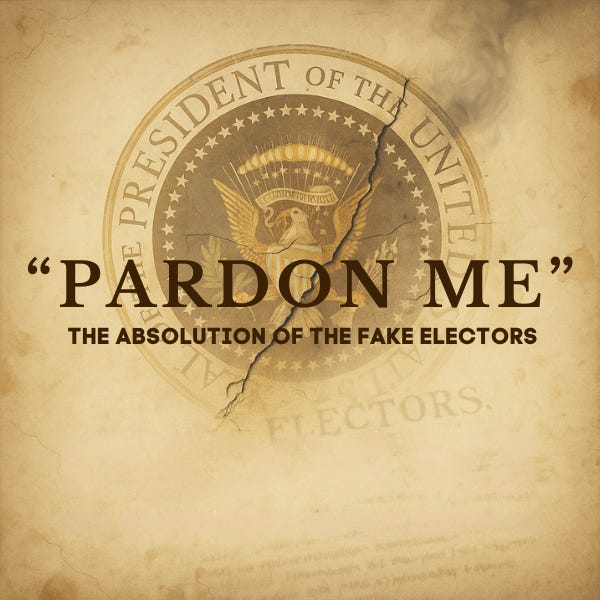
“Pardon Me,” Part II — The Absolution of the Electors
A meditation on impunity, memory, and the death of accountability

“Woe to those who call evil good and good evil,
who put darkness for light and light for darkness.”
— Isaiah 5:20
When the pardons began trickling out of the White House during Trump’s first term, they carried the usual scent of politics—favor for loyalty, mercy for friends, silence for sale. But now, barely ten months into his second, they have become something darker—something that transcends cronyism and edges toward moral erasure. The presidential power to forgive is no longer a gesture of mercy; it is a mechanism of control, a declaration that law itself bends to allegiance.
The latest clemency wave—more than seventy pardons tied directly to the 2020 election-interference effort—marks the full evolution of that theology. The names themselves tell the story: Rudy Giuliani, Mark Meadows, John Eastman, Jenna Ellis, Sidney Powell, and Kenneth Chesebro, along with dozens of “alternate electors” across Arizona, Michigan, Georgia, Pennsylvania, and Wisconsin. [1] Each had participated, to varying degrees, in the attempt to overturn the certified vote of the people by substituting a false slate of electors, thereby throwing the election back to the states. [2]
The scope of the clemency order itself was unprecedented: a blanket pardon covering “all United States citizens for conduct relating to the advice, creation, organization, execution, submission, support, voting, activities in, or advocacy for or of any slate of presidential electors ... in connection with the 2020 Presidential Election.” Although largely symbolic, it served as a public declaration that subverting democracy in the service of the leader is not a crime, but an act of loyalty.
The moral obscenity of these pardons lies not only in the crimes forgiven, but in what they reveal about the new nature of power. A pardon, historically, was meant to temper justice with mercy; now it functions to abolish justice altogether. The ancient covenant between conscience and consequence has been annulled. Those who sought to subvert democracy are not only unpunished—they are canonized as martyrs of the cause.
To grasp the full arc, one must go back to the first term. The earlier pardons—Michael Flynn, Paul Manafort, Roger Stone, Steve Bannon—were the rehearsal, a proof of concept. [3] Each pardon tested the limits of public outrage and the elasticity of law. Each made the next one easier. By the time the fake-elector conspirators were absolved, the public had become inured to the spectacle of impunity. The machinery of enrichment had become the machinery of exemption.
It is tempting to view this as political corruption, but the deeper wound is theological. Forgiveness, in any moral tradition worth the name, is bound to truth. Confession precedes absolution; repentance restores the relationship. What we witness instead is forgiveness without confession—an indulgence that costs the guilty nothing and leaves the innocent bearing the weight of their unatoned sins. In the Gospel’s economy, such grace is counterfeit.
“They dress the wound of my people as though it were not serious,” laments Jeremiah. “Peace, peace,” they say, “when there is no peace.” (Jeremiah 6:14)
These political pardons do the same—they paper over a mortal wound in the body politic, offering the illusion of reconciliation where there is only rot. The act of clemency becomes a public sacrament of denial.
ABC News reported that, together, the first- and second-term pardons erased more than $1.3 billion in restitution, fines, and forfeitures owed to the government. [4] But the deeper debt—the moral one—remains unpaid. Every unprosecuted elector, every absolved enabler, leaves a deficit in the nation’s conscience that no balance sheet can correct. And because restitution is never made, repentance never begins.
When asked about the wave of election-related pardons, one administration official replied, “These people were patriots.” [5] The statement reveals the inversion that now governs American morality: loyalty to the leader is the new measure of virtue, truth is an inconvenience, and justice is an obstacle. Even religion, which should be the last refuge of moral clarity, often becomes the first accomplice. Across pulpits and airwaves, self-styled prophets defended the pardons as signs of divine favor, echoing the same logic that once excused kings. The Church, in too many quarters, has exchanged its prophetic voice for a chaplain’s blessing of empire.
To the casual observer, the fake-elector pardons may look like political cleanup—a closing of the books on an old scandal. But to anyone who remembers what January 6 was meant to prevent, they represent the consecration of lawlessness. The Republic is being taught to forget. Truth itself is being forgiven for the crime of existing.
And yet, even as conscience collapses, scripture preserves its own memory. There is another line in Jeremiah’s lament: “Stand at the crossroads and look; ask for the ancient paths, where the good way is, and walk in it.” (Jeremiah 6:16) The ancient path begins not with vengeance but with truth. Real forgiveness is never the enemy of justice—it is its fulfillment. Mercy without repentance is not mercy at all; it is permission.
The challenge now is spiritual as much as civic: to remember what was done, to tell the truth in the face of deliberate forgetting, and to refuse the counterfeit grace of impunity. The work of restitution may never be complete, but the work of remembrance must be. If democracy is to rise again, it will not be through another pardon, but through a reckoning—a repentance that money cannot buy and power cannot command.
Endnotes
President Trump Pardons Dozens Related to 2020 Election Interference, Gray Media / WECT, October 2025.
“List of People Granted Executive Clemency in the Second Trump Presidency,” Wikipedia, November 2025.
“List of People Granted Executive Clemency in the First Trump Presidency,” Wikipedia, January 2021.
Katherine Faulders, “The Bombshell Inside Trump’s $1.3 Billion Pardon Market,” ABC News / Substack, November 9 2025.
Donald Trump Pardoning Republicans Sentenced to Prison Sparks Fury, Newsweek, October 2025.